History
H3expresso was developed
by Joan
Massó from the
NCSA Relativity Group and the University of the Balearic
Islands Gravitation Group. The name comes from the idea that it
is a "concentrated" ("espresso") and fast ("express")
version of the full H3 code that solves the general
relativistic Einstein's Equations in a variety of physical scenarios
by using a special choice of gauge, harmonic slicing, that allows to
cast the equations as a First Order Flux Conservative Hyperbolic
system and thus allowing the use of advanced numerical techniques. The
theoretical fundations are described in : C. Bona, J. Massó,
Hyperbolic system for Numerical Relativity, Phys. Rev. Lett. 68, 1097 (1992).
And also in the thesis: Joan Massó,
Numerical Relativity: The Quest for a 3-D Code.
Ph.D. Thesis, Universitat de les Illes Balears, 1992,
where a specialized vector code Tse3 is documented in the appendix.
The H code is a new, efficient parallel version of that code
that has been developed since I came to NCSA in 1993.
Purpose
This "expresso" version has been developed and documented for several
reasons:
Despite all these simplification, H3expresso does contain all the caffeine of the H3.3 code, as the Einstein Equations are implemented in its full glory.
H3expresso has been implemented using FORTRAN 90, CMF, HPF... etc
bla bla bla... soon to be completed... well,
not so soon but I promise it's not gonna be that long.
 Implementation
Rob Gjertsen and Marc Nardulli have added MPI support for many different architectures.
Files and Routines
Input and Output
Makefile
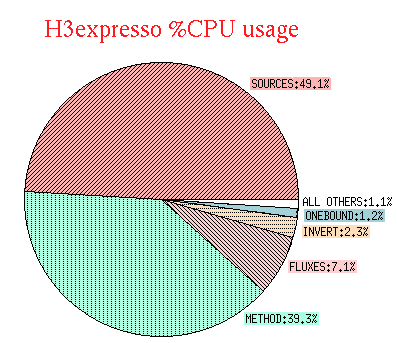
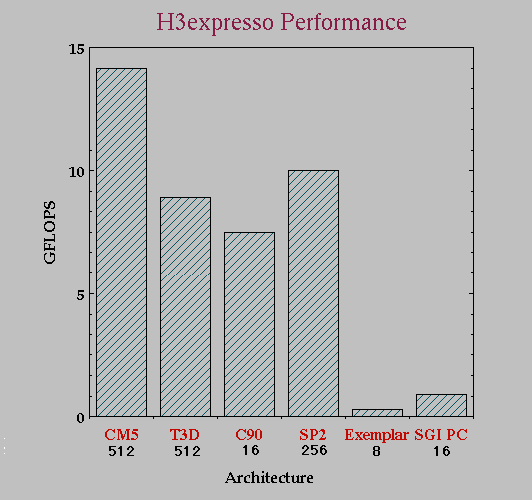
H3expresso has an excellent performance on a variety of
architectures. This is due to the high computation/communication ratio
intrinsic to the Einstein equations. Flowtrace analisys reveals that
the code spends most of the time computing the equations (routines
Sources, Fluxes and Invert), with the finite differencing method
(Method) taking almost all the rest of the time.
Performance
Check the following pages/graphs for a preliminary analysis of the code performance:
Source Code
The H3expresso code is copyrighted and can
not be used without written permission from the author. However,
certain collaborators of the NCSA relativity group may obtain a copy
for special purposes of compiler and toolkit development. These
collaborators will receive a username and password to download the source code. Please, e-mail
Joan Masso for more details.
©
H3expresso Copyright Statement
 H3expresso home page ,
Joan Massó.
H3expresso home page ,
Joan Massó.