
The 3D Einstein equations are solved to describe the simulation of interactions between black holes and gravitational waves in support of design and interpretation of detection experiments.
Inter-Continental Online Visualization and Control of T3E Simulations of Black-Hole-Interactions and Gravitational Waves |
|
Run as demo at SC97 in San Jose, Nov 97 |
|
You can see the poster shown at the demo: |
Ed Seidel (1,3), Lee Wild (1), Joan Masso (1), Paul Walker (1), Manuel Panea (2), Ulrich Schwenn (2), Klaus Desinger (2), Hermann Lederer (2), John Shalf (3), Randy Butler (3), Brian Toonen (4), Ian Foster (4) |
| 1) Max-Planck-Institut
für Gravitationsphysik Albert-Einstein-Institut D-14473 Potsdam, Germany |
2. Rechenzentrum
Garching (RZG) der Max-Planck-Gesellschaft Max-Planck-Institut für Plasmaphysik D-85748 Garching, Germany |
3) National
Center for Supercomputing Applications (NCSA) University of Illinois at Urbana-Champaign |
4) Argonne
National Laboratory (ANL) Argonne, Illinois 60439-4803 |
|
|
||
| The Science
The 3D Einstein equations are solved to describe the simulation of interactions between black holes and gravitational waves in support of design and interpretation of detection experiments. |
||
|
|
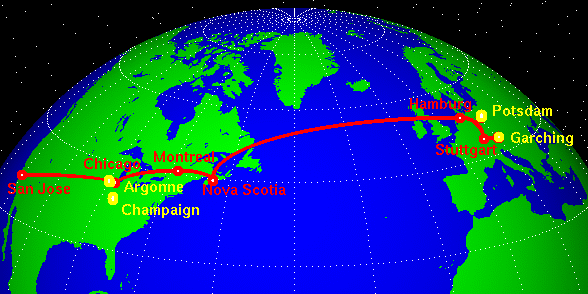 |
| High Performance Networking
An 8,000 mile long inter-continental network connection of 12 Mbit/s bandwidth has been established between San Jose and Garching during the demonstration in order to support the T3E output stream of 1 MByte/s. This has been realized by the help of various providers and partners: Garching/Germany (RZG) --- [B-WiN (DFN)] --- Stuttgart (RUS) --- [public ATM (DTAG)] --- Hamburg / Sylt --- [CANTAT-3 (Teleglobe)] --- Nova Scotia --- [CA*net II (CANARIE INC / NTN)] --- Chicago (STAR TAP) --- [vBNS (NFS)] --- San Jose. Special TCP/IP tuning for efficient long distance transfers has been implemented in the communicating applications in Garching and San Jose. |
|
|
We thank RUS (Rechenzentrum Universitaet Stuttgart), DTAG (Deutsche Telekom AG), Teleglobe, CANARIE INC / NTN and NSF (National Science Foundation) for providing the network connection to enable this demonstration.



![[Reduced size (1280x905 pixels) jpeg file (290 KBytes)]](poster01.jpg)